

Biodegradable plastics by AI: meet Milad Golkaram
How machine learning helps design biodegradable polymers, told by polySCOUT researcher Milad Golkaram. Originally published by TNO.
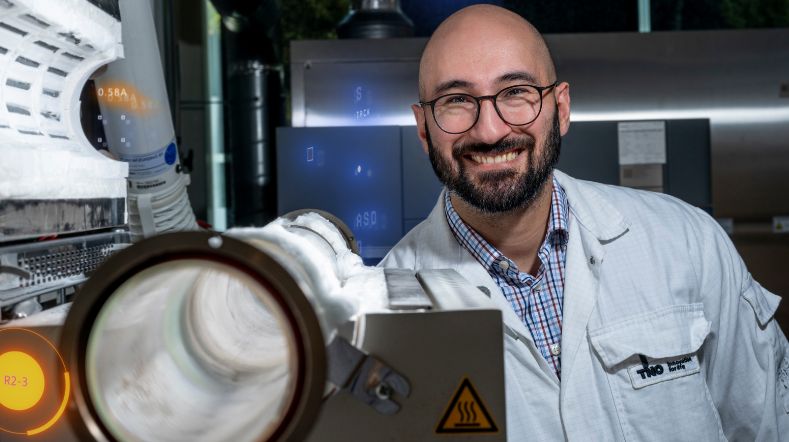
Originally published by TNO on 6 January 2025 as "Time setter story: Working on biodegradable plastics". Source: tno.nl. This is an adapted version. At the time, Milad Golkaram was a scientist in circular economy at TNO and a nominee for TNO's Young Excellent Researcher award.
Plastic is long-lasting, versatile and cheap to produce, but it is often bad for the environment. A team of researchers has built an AI model that makes it considerably easier to develop new biodegradable plastics. One of the key researchers is Milad Golkaram.
An AI model for polymers
Polymers are the building blocks of plastic. Milad's team created polySCOUT, a machine learning programme for developing new biodegradable polymers. As Milad explains, you enter the properties you need, and the model proposes the chemical structure of a suitable polymer.
Already in use
TNO is already applying the approach in practice, for example in the collaboration with Senbis, a textile manufacturer, aimed at biodegradable synthetic textile fibres. Today's synthetic textiles release microplastics that enter the water cycle and end up in our food and drink. Ideally, Milad says, those particles break down before they reach our bodies.
Pushing boundaries
Biodegradable plastics raise many questions. Is it strong enough? Is it sustainable? Can it be scaled up? How long does it last? Is it toxic? Is it affordable? According to Milad, the polySCOUT model is built to address these questions together. He sees this as something unique that pushes the boundaries of science and technology in the field, and believes it can make producing and using biodegradable plastic far more attractive.
Saving time
In his student days, developing new polymers meant trial and error in the lab, a process that could take years. A machine learning model keeps learning about polymer properties and spots correlations faster than people can, so the desired result comes much sooner.
Some people are sceptical about AI or find it too complicated, Milad says, but they are positively surprised once they see what polySCOUT can do. As a result, several companies, mainly in the Netherlands, wanted to work with the team. The next challenge at the time was getting a foothold in the rest of Europe.
Putting the puzzle together
For Milad, polySCOUT combines his three biggest motivations: polymer science, sustainability and AI. He compares the work to putting a puzzle together, with each team member contributing deep knowledge from a different field. In his view, that interdisciplinary way of working is what makes the approach special.
Source: TNO, "Time setter story: Working on biodegradable plastics", tno.nl, 6 January 2025. Adapted with attribution.